

Between freshness, umami and subtle bitterness
Hardly any tea stands for clarity and lively freshness as much as Sencha. Its taste can range from delicate and sweetish to intensely green, herbaceous and rich in umami. In addition to origin and harvest time, the processing of the leaves and the way their oxidation is stopped immediately after plucking are decisive.
While with Oolong or black tea, oxidation is specifically used to develop aromas, Sencha remains largely unoxidized. This preserves the fresh, vegetal character of the green tea leaf – with natural sweetness, subtle bitterness and a clear structure.
What is Sencha tea?
Sencha refers to a classic Japanese green tea style. In traditional Sencha, the freshly harvested tea leaves are first steamed, then rolled, shaped and dried.
The heat inactivates the natural enzymes of the leaves and prevents further oxidation. This preserves the green color and the characteristic freshness of the tea.
High-quality Sencha can be characterized, among other things, by:
- fresh, green and vegetal aromas
- fine natural sweetness and umami
- a clear, lively structure
- a subtle, invigorating bitterness
- a soft mouthfeel
- a fresh, elegant finish
However, Sencha is not a uniform taste type. Tea variety, origin, harvest time and processing determine whether it appears rather light and floral, intensely vegetal, rich in umami or subtly bitter.
What distinguishes Japanese and Chinese green teas?
Japanese and Chinese green teas originate from the same tea plant, but often differ in their processing. Particularly influential is the way in which oxidation is stopped after harvesting.
Japanese green teas: Freshness through steaming
Japanese green teas such as classic Sencha are traditionally briefly steamed. This processing often preserves a particularly green and vegetal aroma. Depending on the tea, notes of fresh herbs, grass or vegetables as well as a subtle maritime nuance can arise.
Many Japanese green teas also show a pronounced balance of freshness, natural sweetness, umami and subtle bitterness. How clearly these characteristics emerge depends not only on the steaming, but also on the tea variety, cultivation and harvest time.
Chinese green teas: Diversity through dry heat
Many Chinese green teas are traditionally fixed in heated pans or drums. The dry heat can produce floral, sweetish, nutty or subtly roasted aromas in addition to vegetal freshness.
A well-known example is Longjing from Zhejiang, which is often associated with soft, nutty nuances reminiscent of roasted chestnuts.
However, this classification is not a rigid rule. Steamed green teas are also produced in China. The country of origin alone is therefore not decisive for the taste, but rather the interplay of tea variety, cultivation, plucking and specific processing.
Where does Sencha come from and what role does Zhejiang play?
The Sencha tradition known today developed in Japan. In the 18th century, a method was developed in the Uji region in which tea leaves were steamed, rolled and dried during processing. To this day, Sencha is one of the most famous Japanese green tea styles.
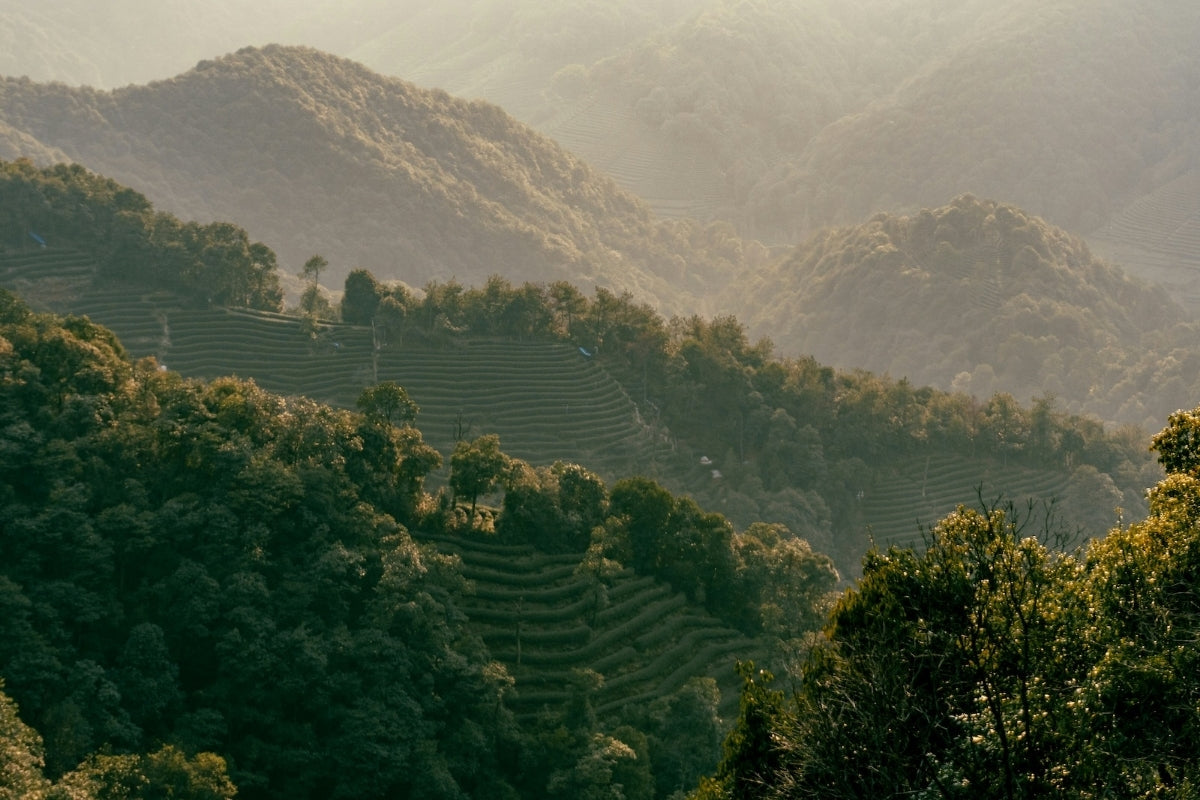
Our Sencha comes from Zhejiang in eastern China – one of the country's most traditional and renowned green tea regions. Zhejiang is particularly known as the home of the famous Longjing tea and stands for a centuries-old combination of tea cultivation and artisanal processing.
Green teas from Zhejiang can develop a wide range of aromas:
- clear, vegetal freshness
- floral and sweetish nuances
- fine herbal aromas
- nutty or subtly roasted notes
- soft, harmonious textures
The interplay of soil, climate and location shapes the growth of the tea plants. Equally decisive, however, are the tea variety used, the quality of the leaf material, the time of harvest and the subsequent processing.
How is Sencha tea made?
Processing begins immediately after plucking. Even small differences in temperature, duration and intensity can significantly change the later character of the tea.
1. Plucking
For high-quality Sencha, young shoots and leaves are harvested at the optimal ripeness. Teas from the first spring plucking are often considered particularly fine and aromatic. However, Sencha can also be made from later harvests.
2. Stopping oxidation
In classic Japanese Sencha, the leaves are steamed immediately after harvesting. The heat inactivates the oxidizing enzymes and preserves the fresh, green character of the tea.
In Chinese green teas, oxidation is often stopped with dry heat in pans or drums. The method used significantly influences the later aroma profile.
3. Rolling and shaping
The leaves are rolled and shaped. Their cell structures are partially opened, allowing the water-soluble ingredients to be evenly extracted during subsequent infusion.
Classic Japanese Sencha often acquires its characteristic narrow, needle-like leaf shape during this process.
4. Drying and refining
Finally, the residual moisture of the leaves is reduced. This makes the tea durable and stabilizes its aroma profile.
The leaves can then be sorted and blended into a balanced composition. The precise control of the individual processing steps determines the freshness, sweetness, umami, bitterness and mouthfeel of the finished tea.
How does Sencha tea taste?
Sencha stands for a clear and immediate green tea aroma. However, depending on the origin and processing, very different taste profiles can develop.
Typical impressions include:
- fresh, green and vegetal notes
- fine herbal and grassy nuances
- natural sweetness and umami
- a clear, subtle bitterness
- a lively structure
- a soft to powerful mouthfeel
Japanese Sencha often appears intensely green, vegetal and more umami-rich. Chinese green teas, on the other hand – depending on their processing – can appear more floral, nutty, sweetish or subtly roasted.
However, these descriptions are only a guide. Even within one country of origin, green teas differ significantly depending on the region, tea variety, harvest and processing.
How to prepare Sencha correctly?
Water temperature particularly strongly influences the taste of Sencha. At higher temperatures, bitter components are extracted more intensely. Lower temperatures often bring out the natural sweetness, umami and finer vegetal nuances more strongly.
As a guide, we recommend:
- Water temperature: approx. 70–80 °C
- Steeping time: approx. 1–2 minutes, depending on dosage
- Multiple infusions: possible
For a second infusion, slightly warmer water can be used and the steeping time shortened.
Those who prefer a particularly soft and sweet infusion choose a lower temperature. For a stronger and fresher character, the tea can be infused a little hotter.
Why is Sencha ideal for Sparkling Tea?
In a high-quality non-alcoholic cuvée, pure aromatics alone are not enough. For it to function as an aperitif or food accompaniment, it needs freshness, structure and length. This is exactly where Sencha brings special qualities.
Its green aromatics give Sparkling Tea:
- clear and lively freshness
- a subtle vegetal bitterness
- precise structure
- natural balance
- culinary versatility
In our interpretation of Sparkling Tea, we combine 24-hour cold-extracted teas with de-alcoholized wine, fine carbonation and a dry, balanced style.
Cold extraction brings out the fine aromas of Sencha in a controlled manner. Fresh and vegetal nuances are highlighted without bitterness or astringency becoming too prominent.
In our Sencha Épicé, Sencha from Zhejiang meets jasmine, Darjeeling, selected herbs, ginger and lemongrass. The green clarity of the Sencha forms the foundation, while floral and spicy components provide additional depth and excitement.
Thus, the cuvée is particularly suitable:
- as a fresh non-alcoholic aperitif
- as an accompaniment to oysters and scallops
- with vegetables and herbaceous dishes
- as a non-alcoholic alternative to sparkling wine or wine
- for festive occasions and shared moments at the table
FAQ: Frequently asked questions about Sencha tea
What does Sencha mean?
Sencha refers to a Japanese green tea style. Classic Sencha is steamed, rolled and dried. The processed leaves are infused with water and then removed.
Is every green tea a Sencha?
No. Green tea refers to a large category of tea with numerous different styles. Sencha is a specific, traditionally Japanese style within this category.
Does Sencha always come from Japan?
The classic Sencha production originates from Japan. Today, however, green teas are also produced in other countries and offered as Sencha or Sencha style. The exact processing can vary depending on the origin and producer.
Is Sencha always steamed?
Classic Japanese Sencha is steamed. In green teas from other countries of origin, oxidation can also be stopped with dry heat. Therefore, the specific processing is crucial for the later taste.
Is Sencha fermented?
No. Sencha is not microbially fermented and is almost unoxidized. The natural enzymes of the leaves are inactivated by heat shortly after harvesting.
Does Sencha contain caffeine?
Yes. Like all classic teas from the tea plant Camellia sinensis, Sencha naturally contains caffeine. The exact amount depends, among other things, on the leaf material, dosage, water temperature and steeping time.
What is the difference between Sencha and Matcha?
In Sencha, the processed tea leaves are infused with water and then removed. Matcha, on the other hand, consists of finely ground Tencha. The tea powder is whisked with water and consumed completely.
Why is Sencha well suited for Sparkling Tea?
Due to its lively freshness, clear structure and subtle vegetal bitterness, Sencha is excellently suited as a component of high-quality non-alcoholic Sparkling Tea cuvées.
In our Sencha Épicé, Sencha from Zhejiang combines with jasmine, Darjeeling, selected herbs, ginger and lemongrass. This creates a fresh yet complex cuvée with elegant spice and a long finish. Discover Sencha Épicé

